Home
/ How To Simplify Radical Denominator Fractions : Multiply And Divide Radicals Mathbitsnotebook Algebra2 Ccss Math, The denominator is a monomial (1 term).
How To Simplify Radical Denominator Fractions : Multiply And Divide Radicals Mathbitsnotebook Algebra2 Ccss Math, The denominator is a monomial (1 term).
How To Simplify Radical Denominator Fractions : Multiply And Divide Radicals Mathbitsnotebook Algebra2 Ccss Math, The denominator is a monomial (1 term).. Simplifying radicals by rationalizing the denominator rationalizing a denominator can be termed an operation where the root of an expression is moved from the bottom of a fraction to the top. Multiplying top and bottom of the fraction by √2 will therefore give us a rational denominator without changing the value of the fraction. Some people prefer this other method of solving problems like this. 1) for how to simplify an expression with difference of squares factoring i. Radical expressions containing denominators are not simplified completely unless the denominator is free of radical symbols.
Radical expressions containing denominators are not simplified completely unless the denominator is free of radical symbols. 👉 learn how to divide rational expressions having square root binomials. Some people prefer this other method of solving problems like this. There are two common ways to simplify radical expressions, depending on the denominator. To rationalize the denominator, (1) multiply the denominator by a number (or expression) which will remove the radical from the denominator.
Free Course Of Algebraic Fractions Www Easycoursesportal Com from www.easycoursesportal.com There are two common ways to simplify radical expressions, depending on the denominator. No variables (advanced) intro to rationalizing the denominator We have to simplify the radical term according to its power. A fraction is simplified if there are no common factors in the numerator and denominator. That means you need to rationalize the denominator! Simplifying the above radical expression is nothing but rationalizing the denominator. The denominator contains a radical expression, the square root of 2. To rationalize the denominator, (1) multiply the denominator by a number (or expression) which will remove the radical from the denominator.
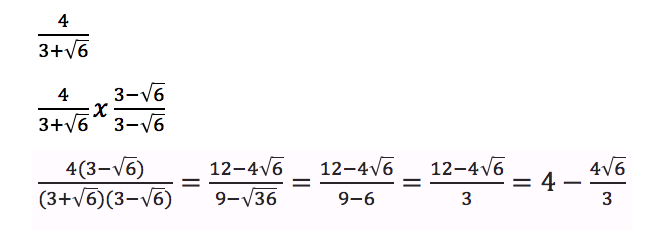
The multiplication of the denominator by its conjugate results in a whole number (okay, a negative, but the point is that there aren't any radicals):
1) for how to simplify an expression with difference of squares factoring i. Eliminate the radical at the bottom by multiplying by itself which is \sqrt 2 since \sqrt 2 \cdot \sqrt 2 = \sqrt 4 = 2. Then, simplify the fraction if necessary. To rationalize the denominator, (1) multiply the denominator by a number (or expression) which will remove the radical from the denominator. Then to rationalize the denominator, you would multiply by the conjugate of the denominator over itself. To divide a rational expression having a binomial denominator with a square root ra. When dividing radicals, check the denominator to make sure it can be simplified or that there is a radical present that needs to be fixed. When you have a fraction with a radical in the denominator, you need to get that radical out of the denominator in order to simplify that fraction. Expressing in simplest radical form just means simplifying a radical so that there are no more square roots, cube roots, 4th roots, etc left to find. Let's start be reviewing conjugate. It also means removing any radicals in the denominator of a fraction. Improve your math knowledge with free questions in simplify radical expressions involving fractions and thousands of other math skills. The multiplication of the denominator by its conjugate results in a whole number (okay, a negative, but the point is that there aren't any radicals):
When dividing radicals, check the denominator to make sure it can be simplified or that there is a radical present that needs to be fixed. Simplifying the above radical expression is nothing but rationalizing the denominator. For example, let's say that our fraction is 3x √x + 3. Rewrite the fraction as two radical expressions instead. The bottom and top of a fraction are called the denominator and numerator, respectively.
Simplifying Radical Expressions Intro To Conjugates Expii from img.youtube.com To divide a rational expression having a binomial denominator with a square root ra. Rewrite the fraction so there is one root in the numerator and another in the denominator. 1) for how to simplify an expression with difference of squares factoring i. √2 × √2 = 2. Let's take the positive case first. This algebra 2 video tutorial explains how to rationalize the denominator and simplify radical expressions containing variables such as square roots and cube. That means you need to rationalize the denominator! The denominator consists of a single root.
To rationalize the denominator, (1) multiply the denominator by a number (or expression) which will remove the radical from the denominator.
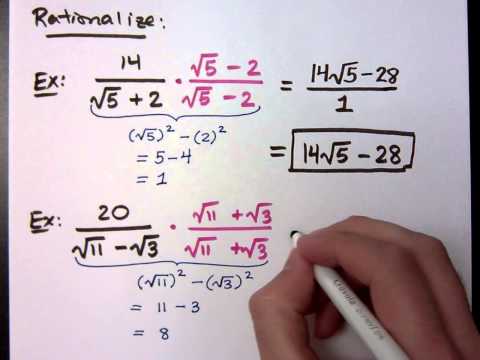
The process of eliminating the radical from the denominator is called rationalizing. The conjugate of a binomial has the same first term and the opposite second term. (2) multiply the numerator by the same number (or expression). To get rid of it, i'll multiply by the conjugate in order to simplify this expression. That means you need to rationalize the denominator! The multiplication of the denominator by its conjugate results in a whole number (okay, a negative, but the point is that there aren't any radicals): Using the identities √a2 = a and (a − b)(a +b) = a2 −b2, in fact, you can get rid of the roots at the denominator. There are two common ways to simplify radical expressions, depending on the denominator. To do this, we multiply both top and bottom by. In this lesson, we will learn how to simplify radicals by rationalizing the denominator. Let's start be reviewing conjugate. Since there is a radical present, we need to eliminate that radical. Then, simplify the fraction if necessary.
Radical expressions containing denominators are not simplified completely unless the denominator is free of radical symbols. A radical expression, n√a, is considered simplified if it has no factors of mn. The multiplication of the denominator by its conjugate results in a whole number (okay, a negative, but the point is that there aren't any radicals): Simplify each root separately, then simplify the fraction. In this lesson, we will learn how to simplify radicals by rationalizing the denominator.
Rationalize The Denominator Simplify How To Calculator Example from www.regentsprep.org To divide a rational expression having a binomial denominator with a square root ra. Since there is a radical present, we need to eliminate that radical. The multiplication of the denominator by its conjugate results in a whole number (okay, a negative, but the point is that there aren't any radicals): To simplify a fraction, we look for any common factors in the numerator and denominator. If the radical in the denominator is a square root, then you multiply by a square root that will give you a perfect square under the radical when multiplied by the denominator. It also means removing any radicals in the denominator of a fraction. That means you need to rationalize the denominator! To rationalize a denominator, start by multiplying the numerator and denominator by the radical in the denominator.
√2 × √2 = 2.
Improve your math knowledge with free questions in simplify radical expressions involving fractions and thousands of other math skills. To rationalize the denominator, (1) multiply the denominator by a number (or expression) which will remove the radical from the denominator. To rationalize a radical expression, multiply the numerator and the denominator by the conjugate of the denominator. In this tutorial, see how to rationalize the denominator in order to simplify a fraction. The denominator contains a radical expression, the square root of 2. 1) for how to simplify an expression with difference of squares factoring i. Therefore, we need to rationalize the denominator to move the root from the denominator/bottom of the fraction to the numerator/ top. Let's take the positive case first. Let's start be reviewing conjugate. Then to rationalize the denominator, you would multiply by the conjugate of the denominator over itself. If you're working with a fraction that has a binomial denominator, or two terms in the denominator, multiply the numerator and denominator by the conjugate of the denominator. To get rid of it, i'll multiply by the conjugate in order to simplify this expression. (2) multiply the numerator by the same number (or expression).
The denominator here contains a radical, but that radical is part of a larger expression how to simplify radical fractions. It also means removing any radicals in the denominator of a fraction.

.)